
Reviewed · OLD TOWN WALKING TOURS
2 Hours Walking Tour in Legends and Secret of Riga’s Old Town
Riga has a gift for storytelling, and this walk is interesting because it turns familiar landmarks into clues. You get a guided path through squares and alleys where symbols matter, from the famous golden roosters to the city’s merchant and church lore.
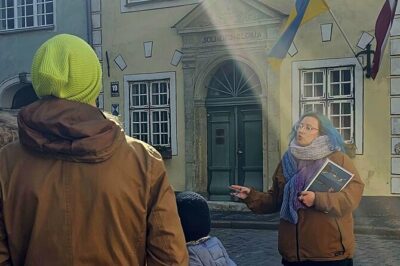
I especially love how the tour helps you get your bearings fast. Town Hall Square, the guild buildings, Dome Square, and the cathedral area all click into place as one connected map, not a pile of photos. I also like that the guide, Lina, stays entertaining and uses visual aids, like a picture folder showing how key sites looked through major moments.
One possible drawback: at the churches, you mainly experience the free areas rather than a full ticketed interior tour at every stop. If you expect a lot of paid rooms, plan your expectations around viewing, context, and a few included admissions.
Key things I’d plan around
- A tight private group: up to 6 people, so questions and slower pacing are easy
- Symbol spotting in real locations: roosters, clocks, and guild icons explained on the spot
- Lina’s teaching style: lots of stories, plus pictures to make changes over time make sense
- Black Balsam tasting included: a Riga specialty stops your feet in a very appropriate way
- Mostly free-area church visits: you’ll still learn a lot, but it is not a full paid church marathon
A small-group Old Town walk that feels like a map, not a checklist
This is a private walking tour for up to 6 people in Riga’s Old Town, run in English. With a route designed for orientation, you’ll leave with a sense of where the “important stuff” sits, plus what most self-guided strolls miss.
The pacing is built for 2 hours 30 minutes total, including short stops and a few timed moments where tickets are part of the experience. It is not a sprint between attractions. It is more like a guided route you can keep using later, even if your next day is spent on museums or lunch spots.
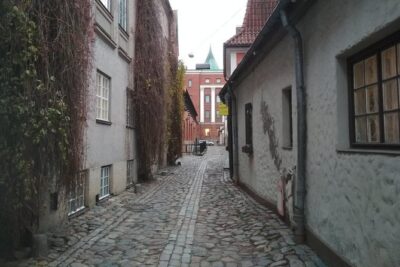
Comfort matters here. The tour calls out comfortable shoes for a reason, since you’ll be moving through older streets and squares where the footing can be uneven.
More Old Town walks in Riga:
- Riga Old Town walking tour
★ 4.5 · 304 reviews - Riga Old Town Walking Tour in a Small Group
★ 4.5 · 132 reviews - Private Riga Old Town Walking Tour
★ 5.0 · 62 reviews
Price and value: what $108.43 per group really buys you
The price is $108.43 per group for up to 6 people. That can look like a lot if you judge it per person, but it is actually aimed at groups who want one guide and one plan.
Where the value shows up is in three areas:
- You get a private format, so the guide can slow down for questions.
- The route is packed with stories and symbolic explanations, not just name-and-date facts.
- The tasting of Riga Black Balsam is included as part of the tour.
If you are traveling solo, the per-person cost effectively goes up. If you are a couple, or a small group of friends, it becomes a smart way to buy time and confidence in a city that rewards noticing details.
The walking route: what the pace feels like in practice
The tour runs through Old Town and nearby historic sights, returning to the meeting point at the end. The start point is the Grand Palace Hotel on Pils Street 12. Pickup is offered, including a pickup location near St. Peter Church at Reformacijas laukums.
Most tours like this move fast, but the strong point here is that the guide seems to build in breathing room for questions. In the real world, that means you can ask about anything you found confusing, like why a rooster matters, or how a particular guild building links to Hanseatic trade.
Also, because it is a mobile ticket tour, it is easier to manage day-of logistics without chasing paper.
From St. Peter’s roosters to Town Hall Square Christmas lore (Stops 1-2)
Stop 1: St. Peter’s Church (outside, oldest Lutheran church focus)
You start by observing St. Peter’s Church from outside, then learn the medieval tradition tied to the church’s golden roosters. The guide also connects the rooster symbol to Christian meaning, not just local folklore. There is even a story about how the number of the beast, 666, is said to have affected the church’s fate.
The experience includes an admission ticket, and you also visit the church’s free part.
Stop 2: Town Hall Square, Ratslaukums
Ratslaukums is described as both the oldest cultural center and one of the prettiest parts of Old Riga, and you’ll see it that way. You’ll hear how the square began as a city market, then became the administrative core. From this spot, you’ll also look toward landmarks tied to Latvia’s identity, like the Latvian National Library and the museum of occupation of Latvia.
You get more than architecture here: the guide tells the story of the Key to Riga and explains how the tradition of decorating Christmas trees began in the 16th century. There is also a memory place dedicated to the first decorated Christmas tree.
Further Riga picks to compare
- Old Town Walking Tour of Riga
★ 4.5 · 28 reviews - Riga Art Nouveau walking tour
★ 4.0 · 27 reviews - Riga walking guided Sightseeing tour
★ 5.0 · 19 reviews - Best Of Riga Walking Tour: Old Town
★ 4.5 · 19 reviews
Black Heads to Dome Square: clocks, freedom, and counting golden roosters (Stops 3-8)
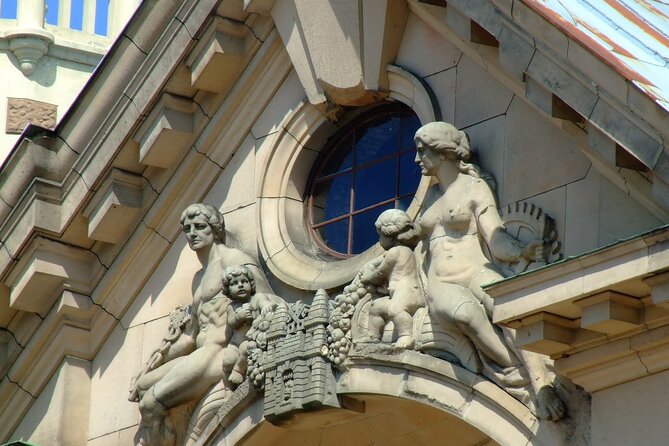
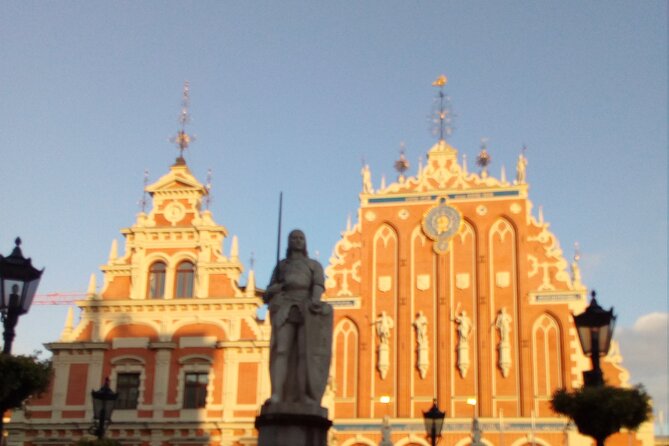
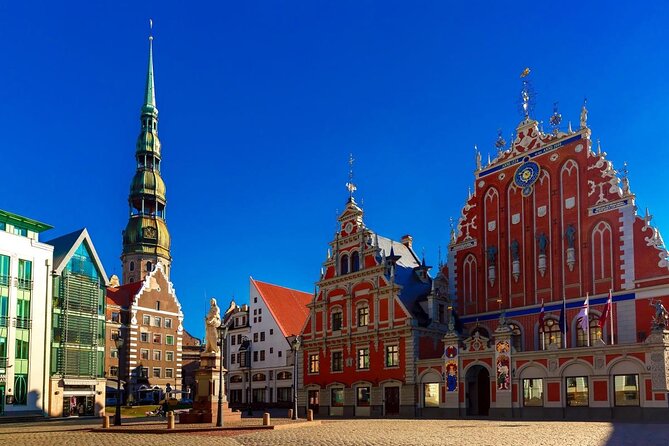
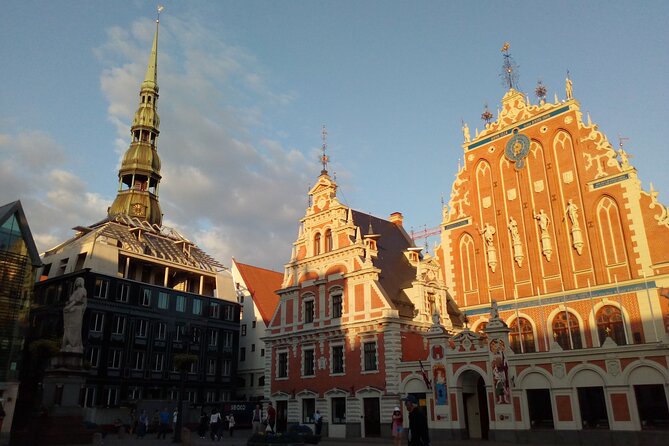
Stop 3: House of the Black Heads
This is a highlight if you like symbolism and secret-sounding stories. The guide explains the building’s decoration, the clock on the facade, and the history of the Black Heads brotherhood. You also get access to the free part of the house and can see details like the underground level and the alchemical hermetical symbolism on the facade.
Admission is included for this stop.
Stop 4: Statue of Roland
Roland’s statue sits in the middle of the square story. You learn how it became a medieval symbol of freedom, and also a sign linked to the Hanseatic Union, since Riga joined the Hanseatic League in 1283. The guide even talks through the tale behind Roland’s shield and sword.
This stop includes admission too.
Stop 5: Riga City Hall and a few weird cool details
You pass the passage area on Jaunavu Street, where the River of Time waterfall is installed for Riga’s 800th anniversary in 2001. You also spot the Contemporary of Pharaoh Tutunkhamen.
No admission is listed here, so think of it as quick “spot and learn” material.
Stop 6: Rozena iela and the medieval wine cellar
Rozena iela is Riga’s narrow street, and you’ll see it in context. From outside, you’ll learn about the oldest Riga City Hall wine cellar from the 13th century. The guide ties the city’s cramped lanes to the idea of streets being called the streets of the drunk knight.
Stop 7: Bremen Town Musicians
This is one of the easiest monuments to recognize, because you see it right in the flow of Old Town. You’ll learn how Bremen and Riga are sister cities and how a Bremen sculptor, Krista Baumgertel, created the monument as a gift in 1990. The story behind it includes the founder of Riga bishop Albert being of Bremen origin.
Quick stop, but it gives you a nice break between heavier symbolism.
Stop 8: Dome Square
Dome Square is where you count golden roosters in the biggest Old Town square view. The guide also points out the square’s geometry, and you’ll connect it to the annual Christmas market tradition.
No admission is listed here, but it is a visual anchor for the next part of the tour.
Riga Cathedral to the Stock Exchange: organ legends and a Venetian gondola (Stops 9-10)
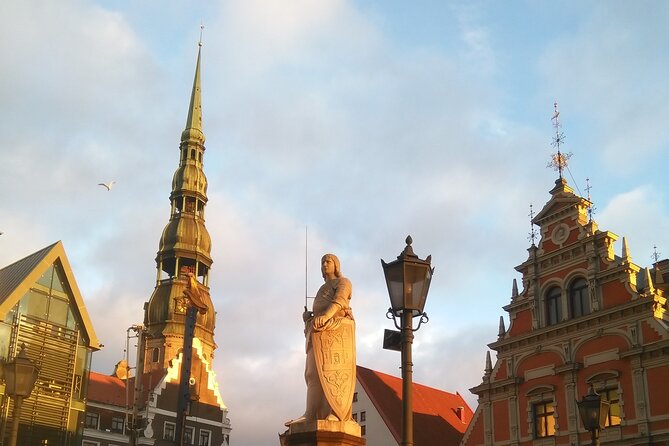
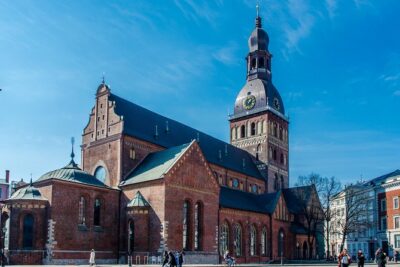
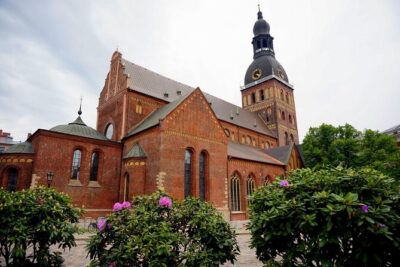
Stop 9: Riga Cathedral
The cathedral is a big visual moment, and the tour makes it easier to understand without turning it into a long church lecture. You’ll learn about the church’s foundation and construction, visit the free part of Dome, and see the last work of Rafael Santi.
You’ll also hear about the pipe organ, once described as the biggest in the world in the 19th century, and now known for outstanding sound. Another fun point: the guide explains how merchants supposedly planned their day by looking at the cathedral’s roosters.
Admission is included here, so this is one of the places where the tour’s value feels most concrete.
Stop 10: Riga Stock Exchange Building
From outside and while passing through its area, you get architecture talk with payoff. You’ll hear the building’s architectural story and see the only Venetian gondola in Riga. It is described as a Venetian Neo-Renaissance gem built in the 19th century, and it now hosts a museum of foreign arts.
Admission is included for this stop, so it is more than a look and a talk.
Three Brothers to Swedish Gate: narrow lanes, taxes, and a ghost story (Stops 11-14)
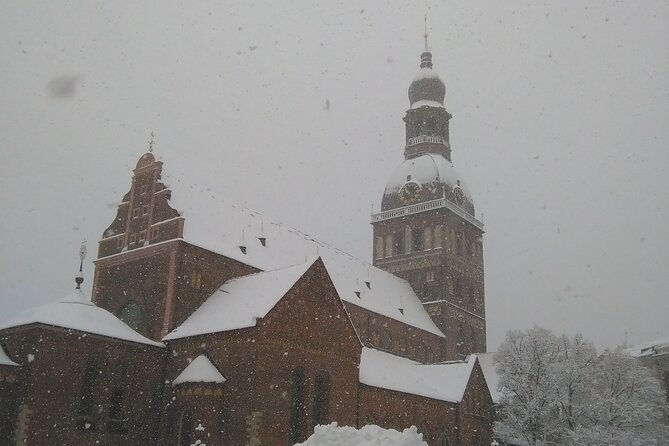
Stop 11: Three Brothers, Latvian Museum of Architecture
The “Three Brothers” are an Old Town storytelling set in three houses, showing different periods of dwelling-house construction. You’ll visit the oldest dwelling house from the 15th century, and the museum connects the architecture to life and work. In the inner yard, there’s also an oldest coat-arm of Riga you can see.
The guide adds an unusual angle with the window tax, including how windows turned into a tax issue in medieval Riga.
No admission is listed here, so you get explanation and access in a shorter slot.
Stop 12: St. Jacob’s Catholic Cathedral of Riga
You’ll see it from outside, then get a specific legend: the bell of the poor sinners, said to ring when a criminal was brought from prison to the Town Hall Square to be executed.
This is a reminder that Old Riga stories often include both pride and punishment.
Stop 13: Powder Tower
Powder Tower is the biggest and only surviving 14th-century tower, and you’ll observe it from outside. After the tour, you can visit the Latvian War Museum that Powder Tower hosts now, and the data says admission to the tower and war museum is free.
So even if your tour stops are short, this is one of the places where you can extend your day.
Stop 14: Swedish Gate
You’ll see the lone outer gate tied to the Swedish period, which explains the name. The guide also mentions the house of the city executioner and shares a Riga ghost legend.
It’s brief, but that mix of structure plus story is the tour’s style.
Jacob’s Inn to Black Magic Bar: soldier walls and alchemy you can taste (Stops 15-16)
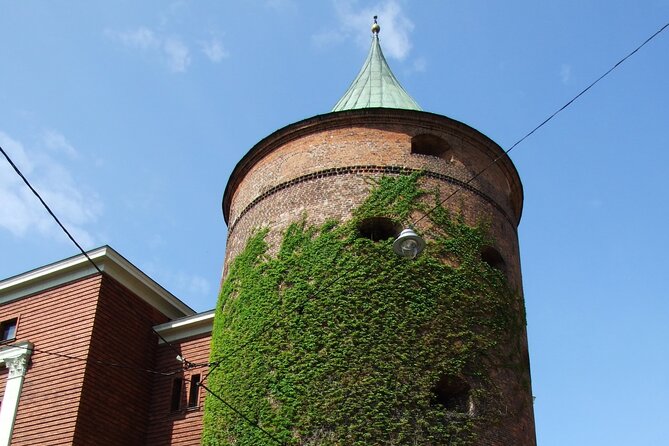
Stop 15: Jacob’s Inn Riga
This is the longest building of Old Town, and the tour explains why it was originally built as barracks. The site is described as housing 5,000 Swedish soldiers. Today, it is used for souvenir shops, cafeterias, restaurants, and offices.
No admission is listed, so it works as a quick history-reset before the tasting stop.
Stop 16: Black Magic Bar, Riga Black Balsam tasting
Here’s the moment that makes the walking tour feel like more than lectures. The guide ties local legend to the idea that Riga Black Balsam was invented in the 18th century, even though the story’s phrasing is legendary rather than clinical.
You get the chance to sample Riga Black Balsam and learn the hidden alchemy symbolism, plus you can see a secret door said to lead to the laboratory of the alchemist Kunze, inventor of Black Balsam.
Alcoholic beverages degustation is included.
If you do not drink alcohol, you might want to ask what the tasting includes before you commit, since the tour lists it as an alcoholic tasting.
Freedom Monument to Cat House: symbols in Latvia’s modern heart (Stops 17-21)
Stop 17: Freedom Monument
You’ll see one of Latvia’s biggest monuments and hear what it means to Latvian people. The guide focuses on hidden symbolism and connects the monument to the first Latvian Republic.
This part shifts the tone from medieval trade to national identity, and that contrast is useful.
Stop 18: Laima Clock
Laima is a major chocolate producer in Latvia, and the guide ties the clock to the name and the idea of meeting points. If you want one practical takeaway, it is this, because the clock is easy to return to later.
Stop 19: Ķēniņu iela
A short street in Old Town, described as Riga’s shortest, is where the guide explains why it became so short many years ago. The stop is quick, but it’s exactly the kind of “why is that like that?” question this tour is good at answering.
Stop 20: Cat House
Cats are a symbol in Riga, and here you get the Cat House legend and how a black cat became part of the Old Town identity story.
This is a light moment in the best way, especially if you want a break from heavier political or religious topics.
Stop 21: Livu Square
You learn the square’s history and hidden symbolism, then see the Liv’s head monument.
No admission is listed, so it is a fast visual moment plus meaning.
Guild buildings, the Baltic Way footprint, and a Russian Empire theatre (Stops 22-27)
Stop 22: Small Guild of Riga
Small Guild is a craftsmen union building, erected in 1864 to 1866 in Neo-Gothic style. The guide explains the story of the union and connects the building’s form to the job of its members.
This is a short stop, but it matters if you want to understand who actually built and traded what in Riga.
Stop 23: Great Guild
The Great Guild is linked to the merchants and is described as existing from 1354 to 1936. The tour frames Riga’s ties to the Hanseatic League in 1283 and explains why German guilds became more prominent.
No admission is listed, but the context helps you read the rest of the Old Town buildings as part of a system.
Stop 24: Baltic Way Footprint Monument
This is not a medieval clue. It is a modern memory mark for the Baltic Way, when about 2 million people formed a 600 km human chain from Tallinn to Vilnius via Riga. The guide also ties it to the 50th anniversary commemoration related to the Molotov-Ribbentrop Pact on August 23, 1989, while the nations were still occupied.
You’ll see a small red granite footprint near Kaļķu and Vaļņu, near McDonald’s. It is a stark reminder that politics lives in public space.
Stop: an old Russian theatre outside Russia
Right after that, you get a quick look at one of the oldest Russian theatres outside of Russia, built in the second part of the 19th century in Florentine Neo-Renaissance style. The tour uses it as another style-and-era marker so you can sense how Riga shifted over time.
Stop 25: St. John’s Church
The guide shares a chilling story: two Dominican monks said to have been walled up alive into the wall, then found in the 19th century during reconstruction work. You’ll also see what is described as the oldest Riga gate leading to the Dominican monastery.
No admission is listed, but the story can stick in your mind for a long time.
Stop 26: Vecriga fortification wall
You’ll see a section of the Old fortification wall built by Germans during the Livonian Order time to protect Riga from invaders. It’s a rare chance to visualize defense as a physical thing, not just a historical phrase.
No admission is listed, since you mainly observe.
Stop 27: Kalēju iela
Kalēju iela is the longest street of Old Town, and the tour connects it to the river. In the past, it was an embankment of the Riga River, and now it reflects the blacksmith street history.
Again, quick, but it helps you understand how cities reuse space as they change.
Kalēju iela to the Radio and TV Tower: a Soviet-built skyline marker (Stop 28)
Stop 28: Riga Radio and TV Tower
You’ll see Riga’s Radio and TV Tower, described as the tallest tower in the European Union, built between 1979 and 1989 with funding from the Soviet Union. Its highest point reaches 368.5 metres.
This stop widens the story beyond Old Town. If you like seeing the full timeline of a city, this helps.
First Christmas Tree marker: why Riga calls itself a town of four capitals (Stop 29)
Stop 29: First Christmas Tree marker
You’ll end at a memory plaque dedicated to the first decorated Christmas tree of 1510. Then the guide explains why Riga is called a town of four capitals.
It is a fitting last stop because it ties the tour’s themes together, symbols and traditions that survived long enough to become public meaning.
Should you book this Riga Legends and Secret of Old Town walking tour?
Book it if you want more than a list of attractions. This tour is designed to help you understand Riga, with Lina guiding you through symbols, guild power, church lore, and modern identity markers, all while keeping the walk light and question-friendly.
Skip it or at least adjust expectations if you are chasing a lot of full paid interiors. The churches include free-area viewing, and only certain stops list admission tickets. You will still learn a lot, but it is not built like a museum pass.
For your best experience:
- Bring comfortable shoes, because the charm requires walking.
- Plan to ask questions. This guide is at her best when you lean in.
- Treat the Black Balsam tasting as part of the culture, not just a drink token.
If you are in Riga for a short time, this is a strong first stop. It gives you a map in your head, plus stories you will recognize the next time you see a rooster, a guild facade, or a square that suddenly feels like it has a plot.
FAQ
How long is the walking tour?
It lasts about 2 hours 30 minutes.
How many people are in a group?
The tour is private, and it is up to 6 people per group.
What is the price?
The price is $108.43 per group.
Is the tour offered in English?
Yes, it is offered in English.
Does the tour include pickup?
Yes, pickup is offered. Pickup details mention St. Peter Church in Riga, Reformacijas laukums.
Where does the tour start?
The start point is Grand Palace Hotel, Pils Street 12, Riga 1050 Latvia.
What is included in the tour price?
A Riga Black Balsam tasting in a souvenir shop is included, and some stops have admission tickets included as noted.
Are entrance tickets to churches included?
The tour states that you visit free parts of churches at relevant stops. Some stops list admission tickets included, but the church visits are described as free areas.
Do I need to bring a ticket?
You will have a mobile ticket.
What should I wear?
Wear comfortable shoes.
What is the cancellation policy?
Free cancellation is available if you cancel up to 24 hours in advance for a full refund.
More 2-Hour Experiences in Riga
- Small Group Art Nouveau walking tour 2h
★ 4.5 · 6 reviews
Recently added around Riga
- Tour from Riga to Vilnius: Bauska Castle, Rundale Palace and The Hill of Crosses★ 5.0 · 3 reviews
- Rundale Palace and Bauska Castle from Riga★ 5.0 · 3 reviews
- Hang-Gliding Adventure Over Riga★ 5.0 · 4 reviews
- Private Sightseeing Tour in Sigulda★ 5.0 · 4 reviews
- Ultimate Art Nouveau Experience in Riga – Private Tour★ 5.0 · 4 reviews
- CITY QUEST RIGA: unlock the mysteries of this city!★ 4.0 · 5 reviews
- Private Castle tour from Riga:Rundale, Bauska+Hill of Crosses(LT)★ 3.5 · 3 reviews
- Old Town Sightseeing Tour in Riga by Electro Bus★ 3.5 · 3 reviews
Old Town Walking Tours, compared.

Browse the lists this tour appears in